Is It Illegal to Use an Expired Car Seat? What to Do
Whether using an expired car seat violates the law depends on the current rules where you drive. A blanket answer for the entire United States can mislead parents. For the safety decision, follow the expiration instructions for your exact seat, and stop using it once its permitted useful life ends. Graco, for example, expressly advises against using its seats past expiration. Graco expiration guidance
If you have just discovered an expired seat, start with its label and manual. Confirm the date, use an appropriate replacement before your child’s next ride, and ask the manufacturer about anything you cannot verify. You do not need a long shopping list to begin.
Find the expiration instructions for your exact seat
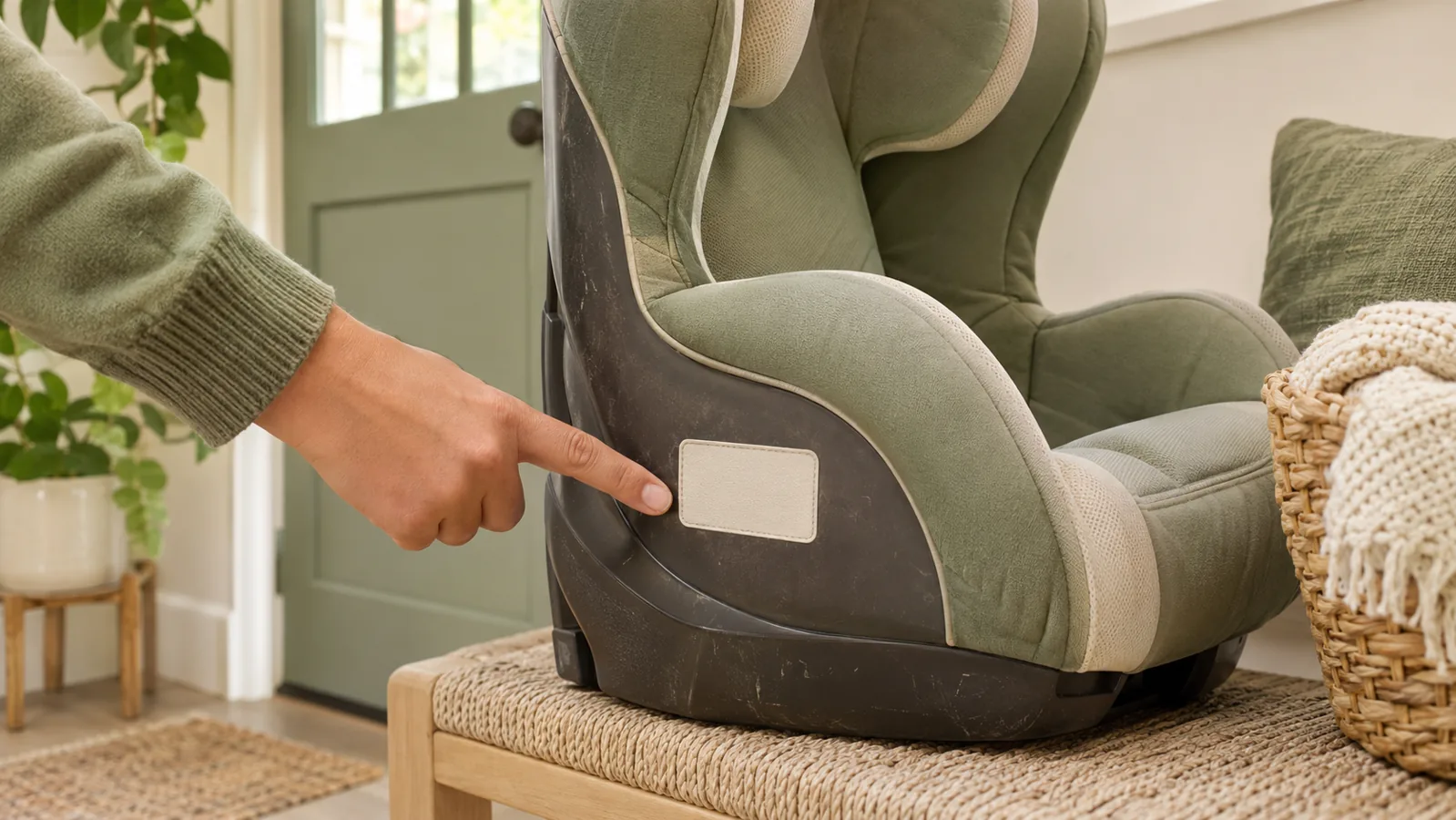
A manufacturing date and an expiration date serve different purposes. Read the wording around the date before deciding what it means. Depending on the model, useful-life information may appear on a label, molded into the shell or in the manual. Check an infant seat’s base as well as its carrier. Chicco identifies several places to look, including the underside and manufacturer label. Chicco expiration guidance
Gather these details first
Write down the manufacturer, model number, manufacture date and any stated expiration or useful-life instruction. Retrieve the matching manual from the manufacturer’s official website. A manual for a similarly named seat may describe a different model or production period.
If the instructions specify a useful life measured from manufacture, use that model’s stated period. Avoid adding a generic number of years found in a buying guide. Graco explains its date calculation using the manufacture date and the applicable useful life; the seat’s purchase date does not replace those instructions. Graco date calculation
If a label is missing, illegible or inconsistent with the manual, contact the manufacturer before using the seat. A photograph can help customer support identify the issue, but keep serial numbers and personal information private when sharing pictures publicly.
Why a good appearance does not settle the question
Expiration is a manufacturer-defined limit for the product. You cannot extend that limit by washing the cover, replacing a cup holder or deciding the seat looks unused. Chicco explains that materials, manufacturing differences and exposure over time contribute to a defined lifespan. Its guidance does not establish one universal lifespan for every brand or model. Why manufacturers set expiration dates
Appearance is still worth checking, but it answers a different question. A seat can have a problem before its expiration date. Conversely, an expired seat can look tidy. Neither observation provides permission to ignore its instructions.
Keep the checks separate: useful life, crash history, recalls, complete parts, suitable child fit and correct installation. Passing one check does not resolve the others. The American Academy of Pediatrics cautions against seats with missing identification, cracks, missing parts or an unknown history. AAP guidance on older and used seats
How expiration relates to child-restraint laws
Look up the current child-passenger requirements for every state where you will drive. Start with the state legislature or an official highway-safety agency. Check the actual instructions required by the law, along with applicable age, size and seating-position rules.
For one illustration, Minnesota defines proper restraint by reference to both the vehicle manufacturer’s and restraint manufacturer’s instructions. Its statute also sets child-restraint requirements. That example shows why searching only for the word “expired” is insufficient. It does not establish the legal outcome for a particular seat or describe every state’s law. Minnesota Statutes, section 169.685, subdivisions 3a and 4a
For a specific citation, dispute or legal question, seek qualified advice in that jurisdiction. This guide does not predict fines, criminal liability, insurance coverage or court outcomes. The practical next step remains to resolve the seat’s permitted use with its manufacturer before travel.
A crash can require replacement before expiration
Expiration and crash replacement are separate decisions. NHTSA recommends replacing seats after a moderate or severe crash. Under its guidance, a crash qualifies as minor only when all five conditions apply:
- The vehicle could be driven away.
- The door nearest the seat was undamaged.
- Nobody in the vehicle was injured.
- Airbags did not deploy.
- The car seat has no visible damage.
Those conditions do not override manufacturer instructions. NHTSA’s full crash-replacement guidance
Use the instructions for your exact seat when deciding what to do after a crash, even if the crash appears to meet NHTSA’s minor-crash criteria. If those instructions or the crash history are unclear, contact the manufacturer before using the seat again.
Check a hand-me-down before considering it
A family hand-me-down needs the same careful review as a secondhand purchase. Ask whether its complete history is known, whether it has been in a crash, whether all required parts and instructions are available, and whether identification allows recall checking. The AAP advises avoiding used seats when their history is unknown. AAP used-seat advice
“Barely used” and “stored indoors” do not answer those questions. Neither does a seller’s photograph. If you cannot establish the information needed to follow the manufacturer’s instructions, choose another option. A familiar source can make questions easier to ask, but familiarity cannot supply missing history.
Check the exact model and manufacture date in the NHTSA car-seat recall lookup. Ask the manufacturer whether a campaign applies to your seat and whether any required remedy was completed. Follow the recall notice’s instructions about use while awaiting the remedy. The NHTSA used-seat checklist also covers crash history, labels, parts and instructions.
Arrange a replacement and retire the old seat
Make a practical replacement checklist
Record your child’s current height and weight, your vehicle details and the seating position you plan to use. Choose a restraint appropriate for your child’s age and size that fits your vehicle and can be used correctly each trip. For a child using a rear-facing restraint, keep them rear-facing until they reach the applicable rear-facing height or weight limit. NHTSA provides seat-selection guidance and an inspection-station finder; technicians can help with installation and use. NHTSA seat selection and inspection resources
If cost is a barrier, contact a local child-passenger-safety program or health department to ask whether assistance is available. Confirm eligibility and availability directly. Plan the next trip around having an appropriate usable restraint rather than continuing with the expired one while shopping.
For disposal, first ask your local waste service or a current take-back program what it accepts and how the seat should be prepared. Follow the manufacturer’s retirement instructions so it cannot be mistaken for a usable hand-me-down. Chicco recommends clearly marking an expired seat and preparing it for disposal under local rules. Do not sell, donate or leave it available for another family to use. Chicco retirement and disposal guidance
Before the replacement’s first trip, read its manual alongside the vehicle manual, check recall information and register the seat with its manufacturer for safety notices. Keep the model details and instructions where every caregiver can find them. NHTSA registration and installation resources
Using a car seat with a stroller?
Read how to check an older stroller separately. A usable stroller does not extend a car seat’s permitted life.
Sources reviewed November 10, 2026. General information based on published guidance; no hands-on product testing or professional endorsement is claimed.